The conversation in most product organisations right now is some version of this: what do we need to change to start getting real value from AI?
It's a good question. And most of the answers being discussed are right — faster iteration, better tooling, new ways of working, different skill profiles. But there's a prerequisite that isn't getting enough attention.
The organisations best positioned to adopt AI aren't the ones moving fastest to buy the tools. They're the ones that already learned to work like product organisations — experimentally, iteratively, with feedback loops, close to customer data, with clear ownership of outcomes.
In other words: the ones that did the Agile work properly.
AI doesn't need Agile. AI needs what Agile was building.
Think about what genuine AI adoption in business processes actually requires from an organisation:
You can't adopt AI without being willing to run experiments, learn from them, and change direction — not just ship features and move on.
AI amplifies whatever you're optimising for. If your org isn't thinking clearly about which user problems are worth solving, AI will help you solve the wrong ones faster.
AI systems improve through feedback — telemetry, eval frameworks, user signals. The infrastructure of learning organisations, not delivery factories.
AI-first delivery requires someone owning the problem space, not just the feature list. One person, one goal, clear priorities.
AI moves fast inside bounded, well-governed teams. It compounds chaos in siloed, handoff-heavy ones.
These aren't new ideas. They're what a serious Agile or product transformation has been building for years. Your teams may already have them — or may have gone further towards them than you realise. The question isn't whether your Agile investment is still relevant. The question is whether you can see it as the foundation it is.
The shift that's coming rhymes with something you've already lived
Here's where it gets interesting for anyone who's been around long enough to remember the DevOps movement.
DevOps moved deployment responsibility to the left — closer to the people writing the code. Developers became responsible for what used to be ops work: build pipelines, infrastructure, release processes. This was the right direction. It removed handoffs, accelerated feedback, and made delivery more continuous.
But it didn't happen overnight. And it created a new challenge: if developers are now deploying to production, what stops them from breaking it? The answer was guardrails — CI/CD pipelines, automated testing, infrastructure as code, monitoring and alerting. You couldn't safely shift left without building the safety net that made it survivable.
That journey took years in most organisations. Some are still on it.
AI-first Scrum is the next iteration of that same pattern.
AI moves execution responsibility further to the left — to the Product Creator, who can now bring an increment from idea to working state using AI, without waiting for a full development team. This is the right direction. It removes more handoffs, accelerates feedback further, and makes the loop between "what should we build" and "does this work" dramatically tighter.
But it creates the same challenge DevOps created: if the Product Creator is now initiating execution directly, what stops them from breaking architecture, quality, or security? The answer is the same pattern — guardrails. Developers (Stewards) who define constraints before development begins, and review generated output before it ships. You can't safely shift left without building the safety net first.
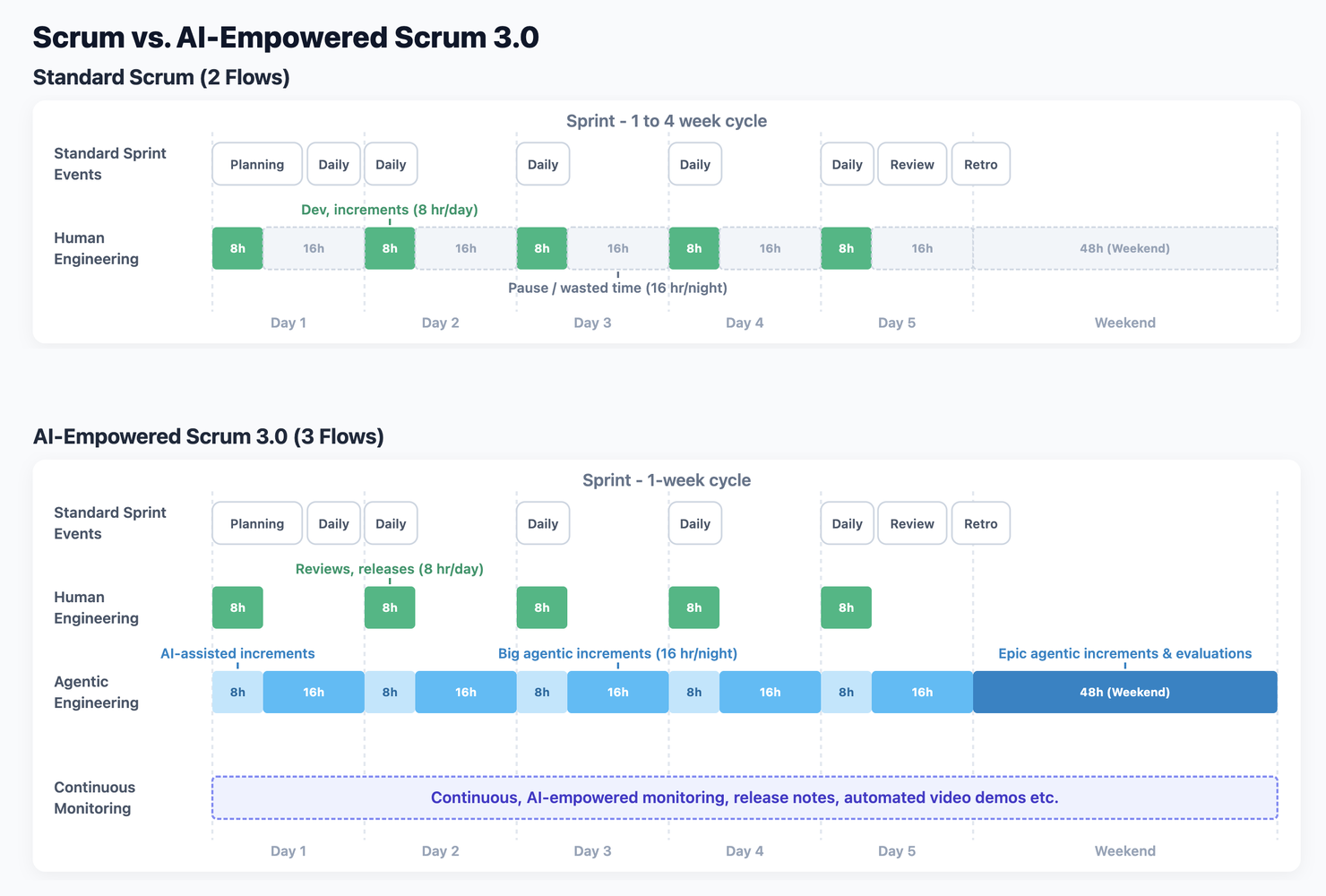
The diagram below makes this concrete. Standard Scrum runs two flows: human engineering works in roughly 8-hour blocks, then stops — nights and weekends sit idle. AI-empowered teams add a third flow: agentic engineering runs continuously through nights and weekends, while human time shifts from producing to reviewing, deciding, and defining what comes next. The sprint tightens from weeks to days. The human role doesn't shrink — it moves upstream.
What the journey looks like
DevOps took years. The early adopters looked experimental and slightly chaotic. The mainstream followed as tooling matured and patterns became clearer. The laggards are still catching up.
AI Scrum will follow the same arc. Nobody's roles have disappeared. The ceremonies haven't collapsed. Most teams are still figuring out what responsible AI-assisted delivery looks like in their context. That's appropriate — this is early, and the cost of moving fast without guardrails is real.
What's clear is the direction of travel:
| Standard Scrum | Direction of travel |
|---|---|
| 2-week sprint delivery | Continuous delivery |
| Status standup | Risk / decision sync |
| Story backlog | Outcome / experiment backlog |
| Velocity focus | Validated outcomes |
| Separated roles | Product creator + guardrails |
Five shifts — from where most teams currently operate, to where AI-first delivery is headed. A direction of travel, not a cliff edge.
What your Agile foundation gives you
If your organisation went through a serious Agile or product transformation — not just the ceremonies, but the culture — you have something that can't be quickly installed:
Teams that know how to inspect and adapt without being told. Vocabulary for discussing failures without blame. Habits of giving feedback on increments before they're done. Practice at running experiments and learning from them. A backlog that, at least sometimes, reflects priorities rather than accumulation.
These are exactly the muscles AI-assisted delivery will demand — at higher frequency and higher stakes. The team that already knows how to retrospect can start retrospecting on AI workflows. The team that's already outcome-focused can apply that focus to what AI should be optimising. The team that learned to work cross-functionally can expand that boundary to include AI agents.
The Agile coach isn't redundant. They're ahead of the next curve.
The Pionäär connection
The coordination physics that govern human Agile teams and AI systems are the same. The forces that pull execution away from intent — execution drift — follow identical patterns in both. Ten years of cross-industry research and eight months of direct human-AI collaboration research confirmed it.
Organisations with genuine Agile discipline have better infrastructure for managing AI drift: clearer ownership, shorter feedback loops, established retrospective practice, product thinking at the centre. The adjustment isn't starting over. It's levelling up what's already there.
The transformation continues. The coach comes back not to rescue it — but to lead it into its next phase.
Want to work through the adjustment together?
The Pionäär Framework provides systematic methodology for exactly this kind of calibration — figuring out what to keep, what to adjust, and how to build the new patterns without discarding what works.