The most common fear when organisations consider AI-first teams is: "Who's left?" The answer is almost everyone — but doing different things, at a higher level, with less tolerance for low-judgment work.
The Scrum Guide has defined three accountabilities rather than roles (since 2020) — Product Owner, Developers, Scrum Master — explicitly allowing one person to hold multiple accountabilities. What AI changes is the practical feasibility and the skill expectations within each.
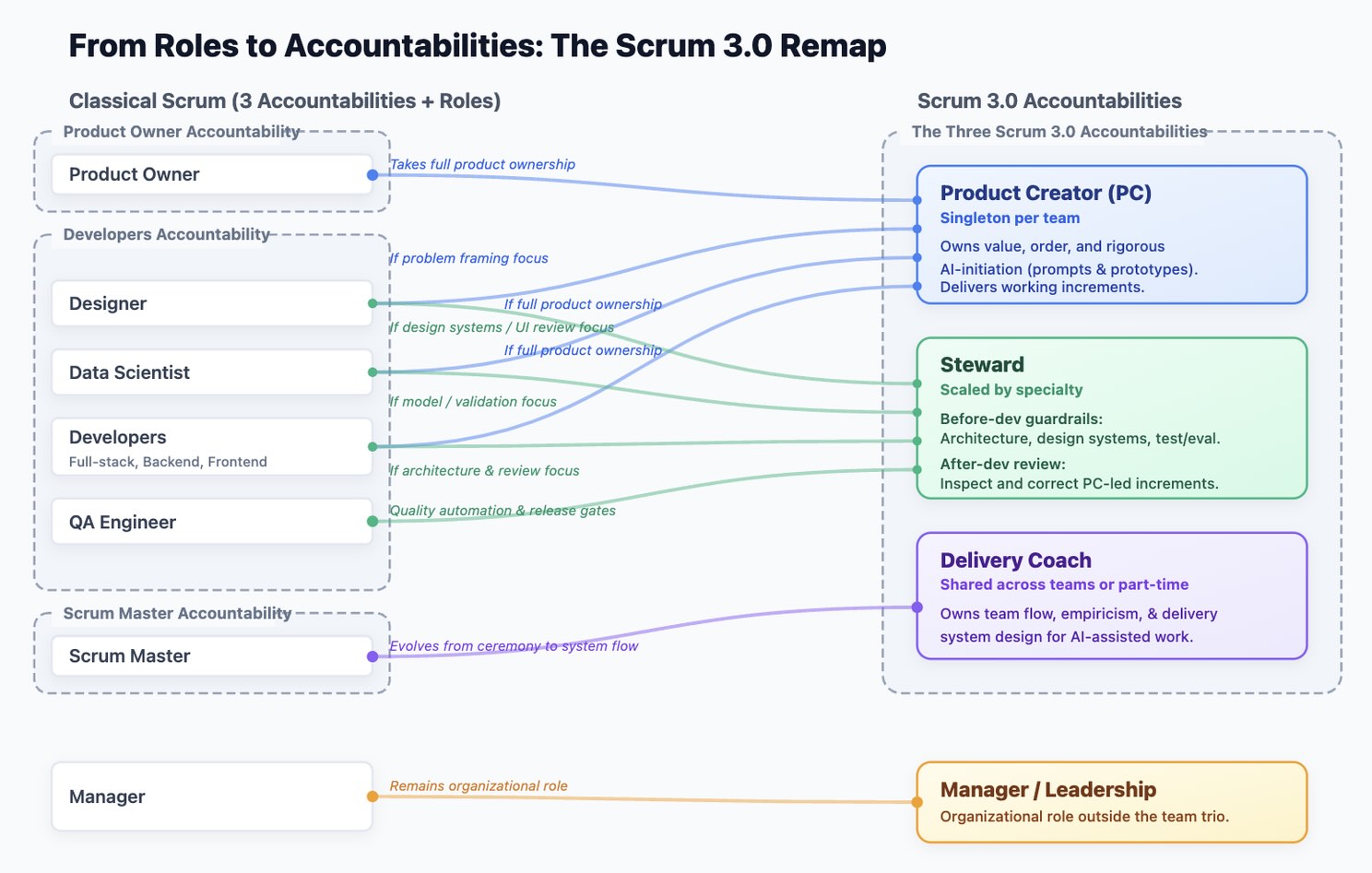
Here are the three accountabilities in an AI-first team, and how classical role titles remap to them.
Owns product goal, priorities, problem framing — plus how AI execution is initiated. More technical than the classic PO.
Defines guardrails before dev. Reviews and corrects AI-generated output after. Judgment over production.
Team flow, impediments, delivery system design for AI-assisted work. Not ceremony police.
The role remapping in detail
The Product Owner accountability remains as the single authority on product goal, backlog order, and acceptance criteria. What changes: the PC is explicitly accountable for how AI execution is initiated. That means owning prompt-writing standards, context packaging, and prototype-creation rules so outputs are reviewable — not throwing a wall of PRD text at the system and hoping. POs who aren't yet technically ready for direct AI execution can still hold this accountability, but must invest in those capabilities. One product creator per team. Always.
Some developers grow into the Product Creator accountability if they take on full product ownership. Most become Stewards. The centre of gravity shifts: before development, they define architecture patterns, integration boundaries, performance and security baselines, deployment expectations. After development, they review and approve PC-led working increments rather than implementing from vague specs. Routine line-by-line coding gets automated; guardrail design and review judgment become even more valuable.
QA doesn't get a separate accountability from engineering. Test strategy, automated checks, regression coverage, AI evals, and risk-based release gates are all before-dev and after-dev Steward work. Their value increases when they define the quality bar that the PC's increments must pass — and enforce it in review — rather than only manually retesting tickets at sprint end.
Designers who focus on problem framing, user research, and rapid prototyping belong with the Product Creator, or become one. Designers who focus on design systems, component quality, and interaction patterns belong with Steward — their before-dev output is the system others must respect; their after-dev work is reviewing PC-generated UI against it. Designers who only produce static assets without shaping product or system quality will find their position weaker in an AI-first team.
The Scrum Master was always meant to be a leader who serves the team, enables empiricism, and removes impediments. Many became ceremony facilitators. The Delivery Coach accountability restores that intent: flow design, operating model for AI-assisted work, governance enablement, dependency management. A strong Scrum Master was already close to this. The evolution is in applying it to a faster-moving system.
What this means in practice
The remap is not "PO disappears, developers disappear, QA disappears." It's an evolution from handoff-heavy execution to higher-value judgment work. In smaller teams, one person may hold two accountabilities. In larger teams, you add Stewards by specialty while keeping one Product Creator per delivery team.
A highly productive Product Creator may need more Stewards than you had developers before AI — because initiating hundreds of increments per day still requires that many people to review, harden, and approve them.
The roles that will clearly shrink: manual ticket grooming, repetitive coding of standard solutions, routine documentation, manual regression testing, status-reporting coordination. The roles that will grow: architecture definition, quality automation engineering, product judgment, experimentation design, governance and risk oversight.
The immediate question shouldn't be "which jobs disappear first?" — it should be: which people can evolve into higher-value work fastest, and how do we redesign the team around that?
Every ceremony, role, and metric — where most teams are and how to get there.
AI ♡ Agile — Article Series
- The Agile Coach Is Back (start here)
- → How Roles Change in an AI-First Scrum Team (this article)
- Your Iteration Speed Is Growing. Your Process Isn't.
- Treat Scope Differently in the AI Era
- AI Demands Adjustment on Your Scrum — Full Guide