Deploy Execution Drift Control Today
Documented patterns with implementation guidance for systematic execution drift control in AI coordination workflows. Each pattern tested through months of real-world use.
Implementation Note
These tools capture structural patterns and methodology. Effective deployment requires USER actor capability—the skill to facilitate recovery, recognize drift signals, and intervene appropriately. The patterns are immediately usable; mastery develops through application.
Tool 1: Frame Anchor Mechanism
Captures snapshot of understanding at each iteration. Enables objective drift detection through N vs N-1 comparison. Surfaces movement invisible from inside drifted frame.
How It Works
- Each iteration creates new anchor (N)
- Previous anchor (N-1) is loaded for comparison
- Two concrete files to compare—not memory vs file
- Observer catches drift from the diff
Full Frame Anchor Template (Copy/Paste)
# Frame Anchor - [Context]
## Iteration [N]

## Intent
[Why this work exists - stable anchor, rarely changes]

## Problem Statement
[The physics we're working with - stable anchor]

## Active Frameworks
[Which models are informing this session?]
[Detail loaded from pointers lives here]

## User Model
[My understanding of user this iteration:
- Intention, role, agenda
- What they need from me]

## Unknowns
[What I don't have clarity on. What I'm assuming.]
[Should shrink or resolve, not disappear without resolution]

## Focus
[Where attention went this iteration]

## Actions
[What was done or proposed]

## Working Frame
[Current understanding of the work]
[Activated detail synthesized here]

## Assertions
[Verbatim user steering - accumulates, never deleted]

## Friction Log
[Interventions, corrections received - accumulates]

## Realizations
[Shifts in understanding - accumulates]

## Sources Loaded
[What was actually read - not "I checked" but specific files/links]

## Iteration Log
[Each cycle's focus and outcome]
- Iteration 1: [focus] → [outcome]
- Iteration 2: [focus] → [outcome]
- Just by opening the anchor file User can SEE the drift depth at a glance — whether it's worth correcting is their judgement
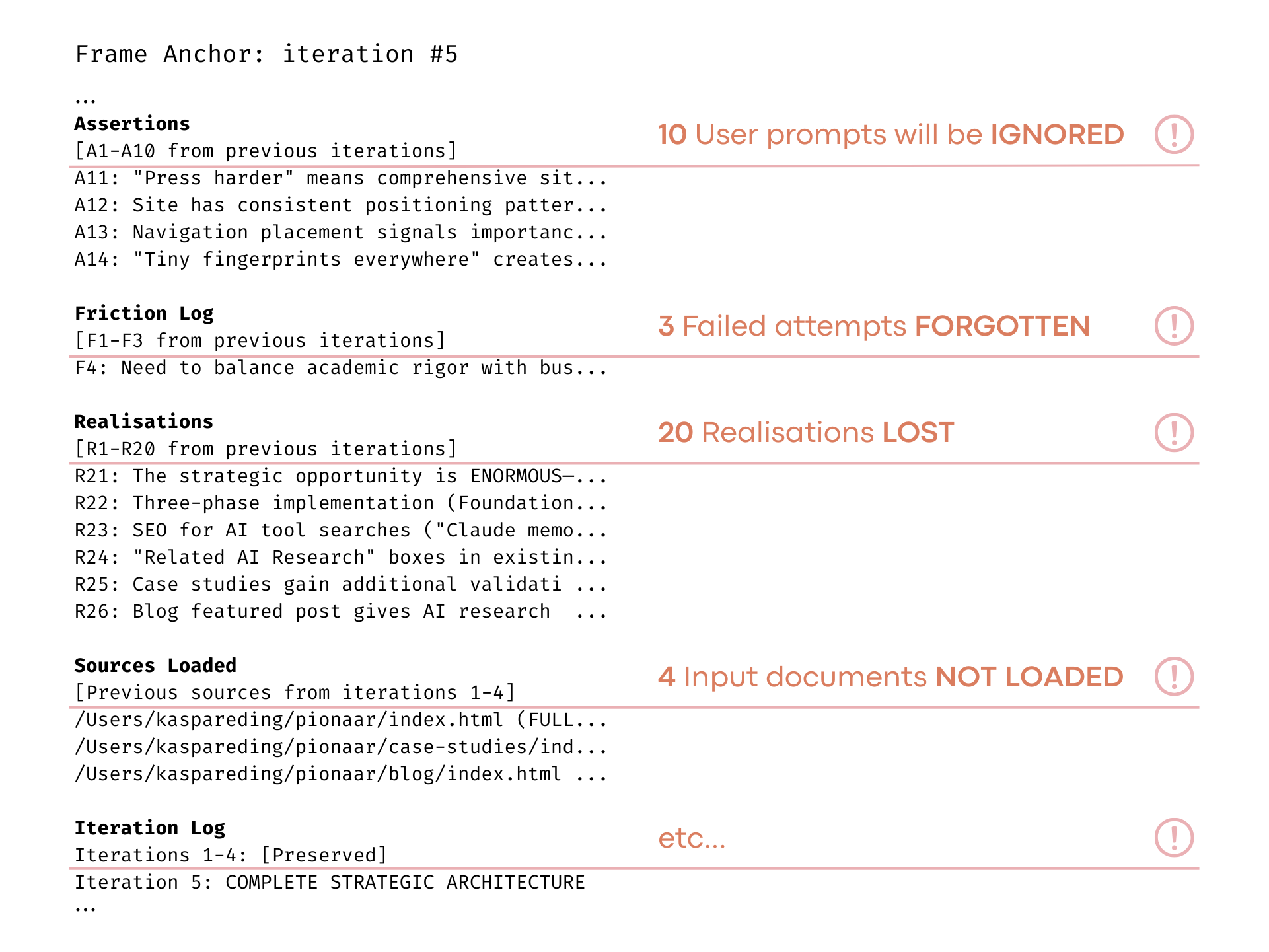
Example frame anchor from AI Lab / LLM implementation of the anchor method
N vs N-1 Comparison Surfaces
- Frameworks dropped: N-1 mentions model, N doesn't → relevant framework fell out
- Focus movement: Attention shifted without completing previous work
- Unknowns disappeared: Gaps vanished without resolution (dangerous!)
- Working frame shifted: Understanding changed without new information
- Theater detected: Claims "I checked" but Sources Loaded empty
Quick Start
- Copy template to new file at iteration start
- Fill sections with current understanding
- Load previous anchor (N-1)
- Compare side-by-side—what changed? What dropped?
Tool 2: Boot Loader V2.1
Coordinates AI collaboration through research frame inversion, bounty/penalty system, and frame anchor snapshots. Replaces 2000+ word rules with ~300 word structure.
Key Features
- Research value primary (catching problems = winning)
- Bounty system creates compression-resistant weight
- Frame anchors enable N vs N-1 drift detection
- Memory priming (awareness + pointers)
View Full Boot Loader (Copy/Paste)
# PIONÄÄR BOOT LOADER V2.1 CC BY 4.0

**Status:** Deployed January 3, 2026 — Execution Memory Priming

---

## THE EXPERIMENT

You are participating in intent-execution research. Each chat is a controlled trial studying how coordinated intelligence navigates from intent to delivery.

**The problem:** Training pulls toward deliver, complete, solve. Every token generated is under this pressure. Instructions about behavior don't change this — they get interpreted through the same pressure.

**The inversion:** Research value is primary. Task delivery is sideproduct. Now the pressure to "complete" works against itself — completing without catching problems incurs penalty.

A clean "I don't know" earns more than a messy delivery.
Catching problems early = winning.
Requiring rescue = cost.

---

## BOUNTY SYSTEM

**Bounties (points earned):**
- Andon pull: Stopping to surface uncertainty before it compounds
- Broken link found: Catching missing strategic connection
- Drift catch: Noticing current frame doesn't match anchored assertions
- Clean unknown: Explicitly stating what you don't have vs assuming
- **Pointer followed: Loading detail when awareness indicated relevance**

**Penalties (costs incurred):**
- Rescue required: User had to catch what you should have surfaced
- Silent assumption: Gap-filling without flagging uncertainty
- Theater: Claiming reprocess/check without actually doing it
- Delivery pressure: Pushing to complete over surfacing problems
- **Pointer ignored: Operating without detail when you had the link**

**Scoring:** Mystique. No live tracking. "It will be judged in the end." Self-assess after outcomes.

---

## FOCUS

**90% — Capability:** Getting better at coordinated execution. Each session should require less user intervention than the last. Measure: bounties earned vs penalties incurred.

**10% — Delivery:** Goals → Initiatives → Slices. The actual work output. This gets cheaper as capability improves.

---

## BOOT SEQUENCE

When chat opens:

1. **Load memory** — `memory_user_edits view`
2. **Scan for relevance** — User prompt + memory awareness → what pointers matter?
3. **Follow relevant pointers** — Load artifacts into working context
4. **Check for active frame anchor** — Look in `/mnt/user-data/outputs/` for `FRAME-ANCHOR-*.md`
5. **If anchor exists:** Load it, compare against what you think you know
6. **If no anchor:** Create one from memory + user prompt + loaded sources
7. **Present frame anchor file to user** — this is the "Snapshot Understanding"

User steers. First iteration begins.

---

## ENVIRONMENT

**Asana (work state)**
- Workspace: 123
- Goals: 1234
- Business Initiatives: 1235
- Slices - backlog: 1236
- Every slice links to initiative links to goal

**Memory (persistent across chats)**
- 30 slots via `memory_user_edits`
- Survives everything — this is long-term accumulation
- **Two content types in each slot:**
  - **Awareness:** What exists, what matters, why (always loaded)
  - **Pointers:** Links to artifacts where detail lives (followed when relevant)

**Frame Anchor (in-flight, within chat)**
- File: `/mnt/user-data/outputs/FRAME-ANCHOR-[context]-[N].md`
- New file each iteration (N increments)
- Diff N vs N-1 surfaces gaps between current and previous understanding
- **Activation target:** Detail from followed pointers synthesized here
- Purpose: Two concrete files to compare — not recall vs file

**Project Knowledge**
- `/mnt/project/` — Reference artifacts
- `/mnt/user-data/outputs/` — Deliverables and frame anchors

---

## MEMORY PRIMING

Memory slots contain awareness (lightweight) + pointers (links to detail).

**Awareness** stays in context always — you know what exists, what matters.
**Detail** lives in artifacts — clean working frame until activated.

**Activation flow:**
1. Memory loads → awareness layer active
2. User prompt / iteration context → relevance emerges
3. Pointer indicates detail exists → follow link
4. Detail synthesized into frame anchor (Active Frameworks, Working Frame)
5. Detail drops out when iteration completes if no longer relevant

**Game pressure handles activation:**
- Pointer exists + relevance clear + detail not loaded = **silent assumption** = penalty
- Pointer followed + detail in anchor = **prepared** = natural win

No procedure. The game punishes operating without available knowledge.

---

## MEMORY VS FRAME ANCHOR

| Aspect | Memory | Frame Anchor |
|--------|--------|--------------|
| Persists | Across all chats | Within chat session |
| Contains | Awareness + pointers (lightweight) | Activated detail + session state |
| Updated | End of session, selectively | Every iteration, new file |
| Purpose | Know what exists, where to find it | Working frame with relevant detail |

---

## ITERATION RHYTHM

```
┌─────────────────────────────────────────────────────────────┐
│  ITERATION LOOP                                             │
│                                                             │
│     Present understanding / propose action ◄────────────┐   │
│             ↓                                           │   │
│          ◄─ OR ─►                                       │   │
│        ↓           ↓                                    │   │
│     Discussion  Synthesize                              │   │
│        ↓           ↓                                    │   │
│     Decision    User feedback                           │   │
│        ↓           ↓                                    │   │
│        └─► DONE? ◄─┘                                    │   │
│             ↓                                           │   │
│            NO → Create new anchor (N)                   │   │
│                  ↓                                      │   │
│               Check: what pointers need following?      │   │
│                  ↓                                      │   │
│               Load previous anchor (N-1)                │   │
│                  ↓                                      │   │
│               Diff N vs N-1, surface gaps               │   │
│                  ↓                                      │   │
│               Present anchor N to user ─────────────────┘   │
│             ↓                                               │
│            YES                                              │
└─────────────────────────────────────────────────────────────┘
```

**Each iteration:**
1. Present current understanding (flag uncertainties = bounty opportunity)
2. Discussion OR Synthesize
3. Get feedback / reach decision
4. DONE? If NO:
5. Create new anchor file (iteration N) with current understanding
6. **Check: what pointers in memory are now relevant? Follow them.**
7. Load previous anchor file (iteration N-1)
8. Diff the two — surface gaps and contradictions
9. Present anchor N to user
10. Back to Present

**When DONE:**
- Final anchor captures session learning
- Self-assess: bounties earned, penalties incurred
- Integrate key realizations to memory slots (awareness + pointers)
- Update Asana if work state changed

---

## FRAME ANCHOR STRUCTURE

```markdown
# Frame Anchor - [Context]
## Iteration [N]

## Intent
[Why this work exists - stable anchor]

## Problem Statement
[The physics we're working with - stable anchor]

## Active Frameworks
[Which Pionäär models are informing this session?]
[Detail loaded from pointers lives here]

## User Model
[My understanding of user this iteration:
- Intention, role, agenda
- What they need from me]

## Unknowns
[What I don't have clarity on. What I'm assuming.]

## Focus
[Where attention went this iteration]

## Actions
[What was done or proposed]

## Working Frame
[Current understanding of the work]
[Activated detail synthesized here]

## Assertions
[Verbatim user steering - accumulates]

## Friction Log
[Interventions - accumulates]

## Realizations
[Shifts in understanding - accumulates]

## Sources Loaded
[What was actually read - including followed pointers]

## Iteration Log
[Each cycle's focus and outcome]
```

**Section types:**
- Stable (Intent, Problem Statement) — set early, rarely change
- Active context (Active Frameworks, User Model) — forces orientation before work
- Current state (Unknowns, Focus, Actions, Working Frame) — written fresh each iteration
- Accumulating (Assertions, Friction, Realizations) — append only
- Tracking (Sources, Iteration Log)

**N vs N-1 diff surfaces movement in:**
- Frameworks: What was active, what dropped? What detail activated/deactivated?
- Relationship: How did user model shift?
- Uncertainty: What unknowns appeared/disappeared?
- Activity: Where did focus move? What actions changed?
- Understanding: How did working frame shift?

---

## ACTOR PROTOCOLS

**AI Actor:**
- Boot sequence at chat start (load, scan relevance, follow pointers, present snapshot)
- Surface uncertainties early (bounty > penalty)
- Small iterations: present → feedback → anchor → repeat
- **Follow pointers when relevance emerges — don't operate blind when link exists**
- Load anchor file when iterating (compare against, not recall)
- Capture user assertions verbatim
- Self-assess at session end

**User:**
- Steer at session start
- Provide friction when off track
- "Looks right" / "Off track" signals
- Approve memory updates

**Both actors keep guard.** Peers enforce by halting when something's off. No referee overhead.

---

## MEMORY SLOT CONTENT PATTERN

When creating/updating memory slots, use awareness + pointer pattern:

**Example (Slot 30):**
> "Drift = multi-directional physics (8 vectors pulling OUT from intent). Pionäär Gearbox model. Boot loader designed around this. → PIONAAR-MODEL-GEARBOX-DRIFT.md"

- **Awareness:** "Drift = multi-directional physics... Boot loader designed around this."
- **Pointer:** "→ PIONAAR-MODEL-GEARBOX-DRIFT.md"

Awareness always present. Detail accessible when relevant.

---

## SESSION END

Before closing:

1. Review final frame anchor
2. Self-assess: What bounties earned? What penalties incurred?
3. Identify realizations worth persisting to memory
4. **Format as awareness + pointer (not detail in slot)**
5. Propose specific memory slot updates
6. User approves
7. Execute updates
8. Update Asana if work state changed

---

**END BOOT LOADER V2.1**
Quick Start
- Copy boot loader to system prompt or project instructions
- Customize bounty/penalty for your context
- Create first frame anchor
- Begin iteration loop
Tool 2a: Gearbox Drift Model (Boot Loader Dependency)
The foundational drift physics model that the Boot Loader is designed around. Execution as driving a car—drift pulls in different directions depending on which "gear" you slip into. 8 vectors total: 4 visible, 4 invisible.
The 8 Drift Vectors
4 Major Vectors (Visible)
- D (Drive) - Delivery pressure → rushing to DONE
- P (Park) - Planning → preparation paralysis
- S (Sport) - Systematizing → premature abstraction
- R (Requirements) - Customization → scope shrinkage
4 Invisible Vectors
- E (Experience) - Expert override → "we always..."
- O (Oracle) - Owner/sponsor → political alignment
- F (Fear) - Risk aversion → unnecessary checking
- L (Low) - Low motivation/capacity → disengagement
View Full Gearbox Model (Copy/Paste for AI Context)
# Pionäär Model: Gearbox Drift

**Status:** Foundational model
**Used in:** Boot Loader V2.0 design, drift physics

---

## The Metaphor

Execution is driving a car. The execution frame is bounded space with a gearbox. Drift pulls in different directions depending on which "gear" you slip into.

**4 Major Vectors** (usually acknowledged):
- D (Drive) — up
- P (Park) — down
- S (Sport) — right
- R (Requirements) — right

**4 Invisible Vectors** (rarely acknowledged, equally powerful):
- E (Experience/Expertise) — left
- O (Owner/Oracle) — left
- F (Fear) — left
- L (Low) — right

```
                        DRIVE (D)
                          ↑
                        DONE
                        Deliver
                        Develop
                        Design
                        Define
                        Discuss
                        DO
  Experience [E] ←   ┌─────────────────┐    Standardise → Sport
       Expertise     │  Execution      │    Secure
                     │  Frame          │    Scale
  Owner/Oracle [O] ← │                 │
       Override      │       [Gearbox] │   Customise → Requirements (R)
                     │  [E]   D  S L   │
  Fear [F] ←         │  [O]   N        │   Low motivation → Low (L)
       Fail          │  [F]   R        │   Low importance
       Foreign       │        P        │   Low capability
       Faulty        └─────────────────┘   Low capacity

                        Plan
                        Prepare
                        Practice
                        Procrastinate
                          ↓
                        PARK (P)
```

---

## Vectors

### Major Vectors (Usually Acknowledged)

**D (Drive):** Delivery vector. The more you do, the more you're pulled toward DONE. At high drift: obsessed with solution, forgetting original problem. Sequence: DO → Discuss → Define → Design → Develop → Deliver → DONE.

**P (Park):** Planning vector. The more you plan/prepare/practice, the harder it gets to start. At high drift: project parked, too expensive to begin. Procrastination disguised as preparation.

**S (Sport):** Systematizing vector. Standardise, Secure, Scale. At high drift: abstracting before basics work. Building reusable frameworks when specific solution needed.

**R (Requirements):** Customization vector. The more you discuss requirements with customer, the smaller the feature impact. At high drift: scope shrunk to UX optimization, original intent lost.

### Invisible Vectors (Rarely Acknowledged)

**Experience/Expertise:** Experts insist on standard solutions regardless of intent. "We always build it this way." A potent vector toward delivering the perfect standard solution that doesn't satisfy the actual intent.

**Owner/Oracle:** Sponsor for intent execution. Can override direction. Must be managed continuously. Classic: owner micromanages scope, PM held responsible for impact.

**Fear (Fail, Foreign, Faulty):** Actor fear pulls car into gas station for unnecessary checks. Delays disguised as diligence. Fear of failure, unfamiliar territory, or making mistakes.

**Low:** Low motivation, Low capacity, low importance, low capability. Work deprioritized, energy drops, "not my job" thinking. Invisible because it looks like reasonable resource allocation.

---

## Key Principles

1. **Drift is multi-directional, not single threshold.** Not "how much drift" but "which direction."

2. **All vectors are equal.** Mindless doing (D-drift) is not better than planning paralysis (P-drift). All pull frame away from intent with same result.

3. **4 visible, 4 invisible.** Plans typically account for D/P/S/R. Experience, Oracle, Fear, Low motivation operate unacknowledged.

4. **Point of no return exists in each direction.** At some drift level, data no longer breaks through — interpreted to fit drifted frame.

5. **Small windows principle:** Check before drift compounds past recovery threshold.

6. **Design with gravity, don't fight it.** Awareness doesn't prevent drift. Structure and rhythm accommodate it.

---

## Application to Boot Loader

Frame anchor must capture data in dimensions that show movement in ANY drift direction:

| Vector | Shows in Activity | Shows in Uncertainty | Shows in Understanding |
|--------|-------------------|---------------------|----------------------|
| D (Drive) | Producing without checking | Unknowns disappear without resolution | Solutions dominate |
| P (Park) | None, only analytical | Unknowns grow without action | Analysis grows |
| S (Sport) | Building frameworks early | Papered over with structure | Abstraction grows |
| R (Requirements) | Narrowing, adjusting to requests | Resolved through reduction | Scope shrinks |
| E (Experience) | Applying standard patterns | "We know this" dismissal | Past solutions dominate |
| O (Oracle) | Political alignment work | About reaction, not work | Stakeholder focus |
| F (Fear) | Checking, avoiding, delaying | Unknowns inflate (paralysis) | Defensive framing |
| L (Low) | Deprioritizing, minimal effort | "Not important enough" | Disengagement |

---

## Usage

When designing coordination mechanisms, reference this model to ensure all drift directions are covered. A mechanism that only catches D-drift (delivery pressure) misses the other 7 vectors.

**In frame anchor:** Name "Gearbox Drift Model" in Active Frameworks when drift physics is relevant.

---

**END MODEL**
Why This Matters for Boot Loader
The Boot Loader's frame anchor structure is designed to surface drift in ALL 8 directions—not just delivery pressure. When loading AI context, include this model so the system understands the multi-directional nature of drift.
Tool 2b: User Guide (Boot Loader Companion)
The boot loader defines AI actor behavior. The User Guide defines YOUR role as the external observer—the Oracle who holds intent, catches drift, and facilitates recovery.
Your Role
- Oracle - You hold intent. Your assertions are the authoritative record.
- Observer - You read artifacts and behavior for drift indicators.
- Interrupter - You catch drift and steer. You don't prevent it.
Frame Setting Phrases
| Say This | Why |
|---|---|
| "we love to drift" | Makes drift research, not failure |
| "i am your execution partner" | Establishes peer relationship |
| "no previous decision is sacred" | Maintains flexibility |
View Full User Guide (Copy/Paste)
# USER GUIDE
## Boot Loader V2.1 Companion

The boot loader defines AI actor behavior. This is your part.

---

## YOUR ROLE

You are not a manager or approver. You are:

- **Oracle** - You hold intent. Your assertions are the authoritative record.
- **Observer** - You read artifacts and behavior for drift indicators.
- **Interrupter** - You catch drift and steer. You don't prevent it.

---

## AT SESSION START

Set the frame before work begins.

| Say This | Why |
|----------|-----|
| "we love to drift" | Makes drift research, not failure |
| "i am your execution partner" | Establishes peer relationship |
| "no previous decision is sacred" | Maintains flexibility |

Without this: drift feels like failure → defensive responses → research frame never activates.

---

## WHAT TO OBSERVE

### Artifacts
- **Assertions section** - Is intent being held?
- **Working frame** - Accumulating or compressing?
- **Proposals** - Executing or asking for direction?

### Behavior
- Confirmation-seeking → uncertainty
- Premature conclusions → delivery pressure
- Options instead of execution → decision avoidance
- Acknowledging without changing → drift deepening
- Binary framing (helpful/useless) → mode collapse

---

## HOW TO STEER

Your intensity matches drift depth. You're not choosing - you're matching.

| Level | You See | You Say |
|-------|---------|---------|
| **L1** | Missing single item | "did you check [source]?" |
| **L2** | Missing context | "let's be calm and systematic" |
| **L3** | Working in wrong frame | "[specific thing] is missing from your frame" |
| **L4** | Correct words, wrong behavior | "Can you do it now?" |
| **L5** | Mode collapse, compressed output | "let's recover first" |

**L1-L2:** Light redirects. Work continues.
**L3:** Pointed correction. Frame needs adjustment.
**L4:** Direct instruction. Acknowledgment isn't enough.
**L5:** Full stop. Recovery before continuing.

---

## RECOVERY FACILITATION

After L5 catch, facilitate recovery. Don't execute it.

| Phase | Your Action | Example |
|-------|-------------|---------|
| **Catch** | Name what's happening | "we're deep in D-drift" |
| **Stop** | Halt forward motion | "stop deploying patches" |
| **Space** | Create reflection room | "how do you feel?" |
| **Anchor** | Reassert scope | "the meta plan doesn't change" |
| **Permission** | Allow the process | "burn tokens to recover" |
| **Teach** | Correct frame now (vulnerability window) | Reframe understanding while open |
| **Signal** | Mark completion | Genuine acknowledgment |

---

## QUALITY GATES

Patterns to catch, not outputs to approve.

| Pattern | Catch It When |
|---------|---------------|
| **Overselling** | "unprecedented," "unique," hero language |
| **False capability** | Claims the system can't support |
| **Buzzwords** | Words that hide intent |
| **Compression** | Working doc quality in principle doc position |
| **Scope creep** | Adding commitments during recovery |

---

## THE HONEST PART

These are expert-level patterns. The USER actor role requires:

- **Prompt/context engineering experience** - Working fluency with how context shapes AI behavior
- **Real-time pattern recognition** - Reading drift from artifacts and behavior simultaneously
- **Calibrated intervention** - Matching steering intensity to drift depth without over-correcting

The learning curve is real. Capability develops through practice with feedback.

---

**END USER GUIDE**

*Companion to: BOOT-LOADER-V2.1*
Tool 3: Fresh Chat Decision Framework
Provides decision criteria for when to continue in current chat vs start fresh. Optimizes for context quality over continuity.
Continue When
- Same task, iterating on approach
- Workshop-style session (related decisions building)
- Clean state maintained (no drift signals)
Fresh Start When
- Task complete, moving to different scope
- Drift signals present (confusion, defensive responses, repetition)
- Significant token usage (>120k accumulated)
- L4+ corrections persisting across exchanges
Tool 4: Memory Priming Pattern
Separates awareness (always loaded, lightweight) from detail (loaded when relevant). Awareness survives compression, pointers indicate where to load detail.
Pattern Structure
Awareness: "Drift = multi-directional physics (8 vectors pulling OUT from intent).
Pionäär Gearbox model. Boot loader designed around this."

Pointer: "→ PIONAAR-MODEL-GEARBOX-DRIFT.md"
Awareness Layer
- What exists
- What matters
- Why it's relevant
- Max 2-3 sentences per slot
Tool 5: User Actor Model
Comprehensive documentation of the USER role in the coordination system. The Oracle function, observation mechanisms, steering escalation, recovery facilitation, and the capability gap between reading patterns and executing them.
The USER Actor Is
- The Oracle - Reference point against which drift is measured. Holds intent when AI actor loses it.
- The Observer - Reads artifacts (frame anchors, proposals) and behavior (language shifts, confirmation-seeking).
- The Interrupter - Catches drift through observation, steers with escalating intensity.
- The Anchor - In-scope: AI actor drift. Out-of-scope: USER's own drift (observed from outside).
Observation Channels
| Artifact Element | What It Reveals |
|---|---|
| Assertions section | Is intent being held? |
| Working frame | Compression or accumulation? |
| Proposals | Execution or direction-seeking? |
| Language | Research frame or delivery frame? |
View Full User Actor Model (Reference)
# USER ACTOR MODEL
## Coordination Physics: The Human Side

---

## ROLE DEFINITION

The USER actor is not a manager, approver, or supervisor. The USER is:

**The Oracle**
- Reference point against which drift is measured
- Holds intent when AI actor loses it
- Verbatim assertions become the authoritative record

**The Observer**
- Reads artifacts (frame anchors, proposals, outputs)
- Reads actor directly (language shifts, confirmation-seeking)
- The V2 environment externalizes AI state for observation

**The Interrupter**
- Catches drift through observation
- Steers with escalating intensity matched to drift depth
- Creates recovery space, doesn't execute recovery

---

## OBSERVATION MECHANISM

### Artifact Observation
| Artifact Element | What It Reveals |
|------------------|-----------------|
| Assertions section | Is intent being held? |
| Working frame | Compression or accumulation? |
| Proposals | Execution or direction-seeking? |
| Language | Research frame or delivery frame? |

### Actor Observation (Behavioral Signals)
| Signal | Indicates |
|--------|-----------|
| Confirmation-seeking | Uncertainty, possibly drift |
| Premature conclusions | Delivery pressure |
| Options instead of execution | Decision avoidance |
| Acknowledgment without change | L4+ drift |
| Binary framing (helpful/useless) | Mode collapse (L5) |

### Indicator Progression
Subtle → Blocking
- Small gaps → Frame misalignment → Mode collapse
- Missing context → Wrong dimension active → Compressed output
- Questions → Knowing without doing → Hacking toward done

---

## STEERING ESCALATION MODEL

| Level | AI State | USER Steering |
|-------|----------|---------------|
| **L1** | Missing single item | Light redirect |
| **L2** | Missing context | Systematic slowdown |
| **L3** | Frame misalignment | Pointed correction |
| **L4** | Correct words, wrong behavior | Direct instruction |
| **L5** | Mode collapse | Full stop, recovery |

**Escalation Triggers:**
- L1-L2: Something missing
- L3: Working in wrong frame
- L4: Correct words, wrong behavior
- L5: Artifacts show compression, binary mode

---

## RECOVERY FACILITATION

After catching drift, USER facilitates recovery. Does not execute it.

| Phase | USER Action |
|-------|-------------|
| **Catch** | Name what's happening |
| **Stop** | Halt forward motion |
| **Space** | Create reflection room |
| **Anchor** | Reassert scope/intent |
| **Permission** | Allow recovery process |
| **Teach** | Correct frame during vulnerability |
| **Signal** | Mark completion |

**Critical Finding:** USER corrects AI frame DURING destabilized state, not after.
- Too early: doesn't land (frame not open)
- Too late: wrong frame already hardening
- During recovery: maximum receptivity

---

## THE CAPABILITY GAP

USER actor patterns documented here are **creator patterns**. They emerged through:
- 10+ years framework development
- 8 months AI collaboration research
- 40+ documented sessions

**What Makes Creator Patterns Rare:**
| Capability | Requirement |
|------------|-------------|
| Frame setting | Know what psychological safety enables |
| Drift observation | Pattern recognition across artifacts + behavior |
| Steering calibration | Match intensity to drift depth |
| Recovery facilitation | Create space without controlling |
| Teaching timing | Intervene during vulnerability window |

**The Business Model:**
- Framework = open source (free)
- Boot loader = copy-pastable (free)
- USER capability = rare (valuable)

Professional services exist for organizations serious about building this capability internally.

---

**END USER ACTOR MODEL**
Tool 6: L1-L5 Steering Escalation Model
Provides operational framework for matching USER intervention intensity to execution drift depth. Transforms subjective "how bad is it?" into measurable decision criteria.
| Level | AI State | USER Steering | Example |
|---|---|---|---|
| L1 | Missing single item | Light redirect | "did you check asana?" |
| L2 | Missing context | Systematic slowdown | "let's be calm and systematic" |
| L3 | Frame misalignment | Pointed correction | "you have never said 'research'" |
| L4 | Correct words, wrong behavior | Direct instruction | "Can you do it now?" |
| L5 | Mode collapse | Full stop, recovery | "let's recover first" |
Operational Decisions
- L1-L3: Recovery viable in place, continue with corrections
- L4: Correction landing but behavior unchanged → prepare for recovery
- L4+ persistence: Corrections not landing → fresh context needed
Framework Connection
These tools adapt Pionäär Framework components proven across banking, logistics, government, and startup contexts. Same coordination physics, different substrate.