Chapter 3: Strategy Will Drift!
The Pionäär Intent-Execution Model: 8 vectors pulling execution away from intent
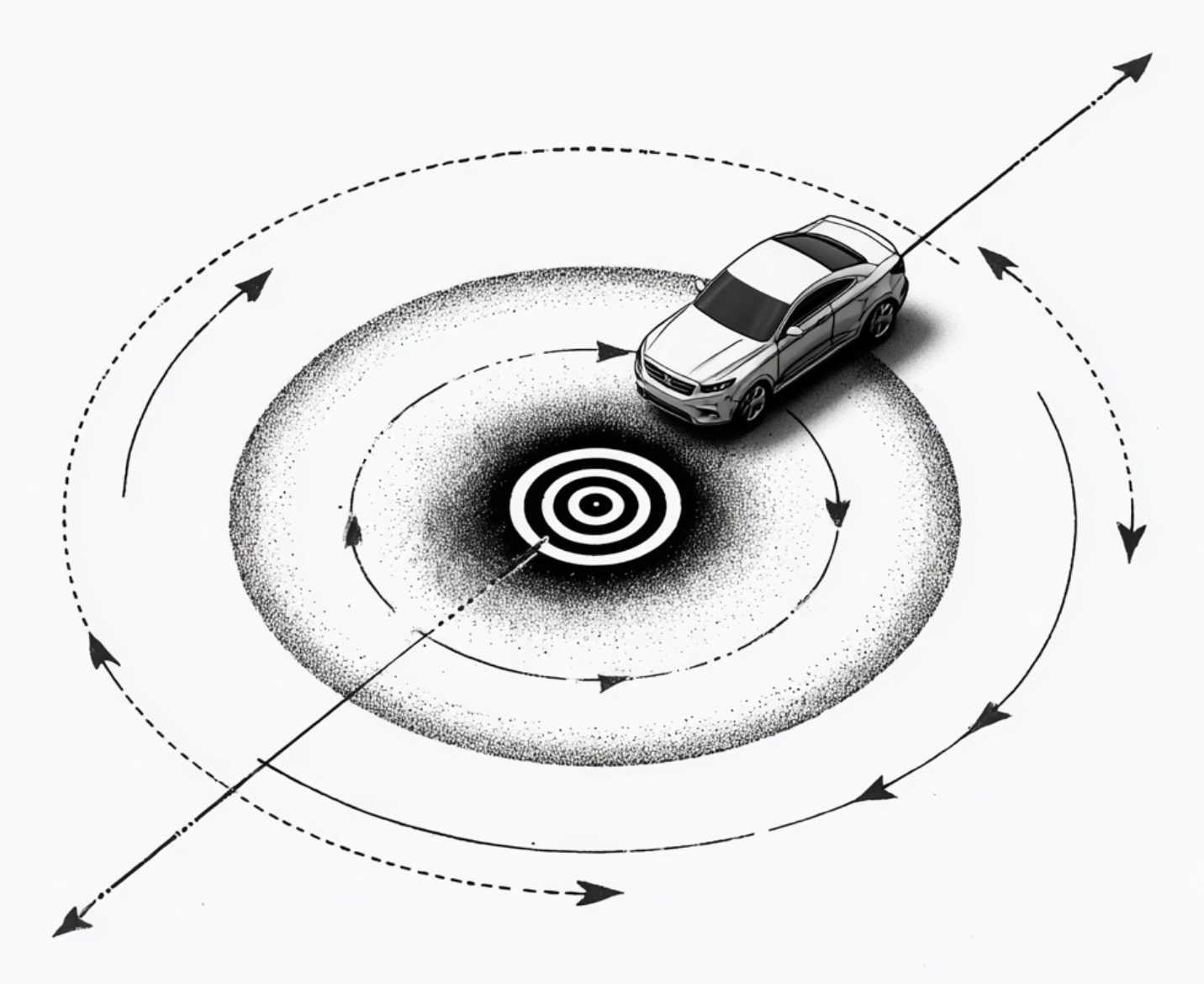
Every plan encounters execution drift. Not from lack of discipline or poor planning—from physics. The Gearbox Model identifies 8 vectors pulling execution away from intent, helping you design WITH gravity instead of fighting it.
You've Experienced This
You define clear intent. Team agrees. Work begins.
Weeks later, you're delivering something different. Not because anyone disagreed. Not because intent changed. The execution frame drifted.
Common symptoms:
- Solutions delivered don't match problems stated
- Planning sessions multiply, starting gets harder
- Team builds reusable frameworks before basics work
- Scope shrinks to UX tweaks, original impact lost
- "We always build it this way" overrides actual need
- Micromanagement increases, accountability decreases
- Fear drives unnecessary validation rounds
- Work deprioritized, energy drops, "not my job" thinking
What's happening? Execution drift operates in multiple directions simultaneously. Understanding "how much drift" isn't enough—you need to know which direction.
The Gearbox Model: 8 Vectors
Think of execution as driving a car. The execution frame is bounded space with a gearbox. Drift pulls in different directions depending on which "gear" you slip into.
Critical insight: All vectors pull OUT from intent. None pull toward it.
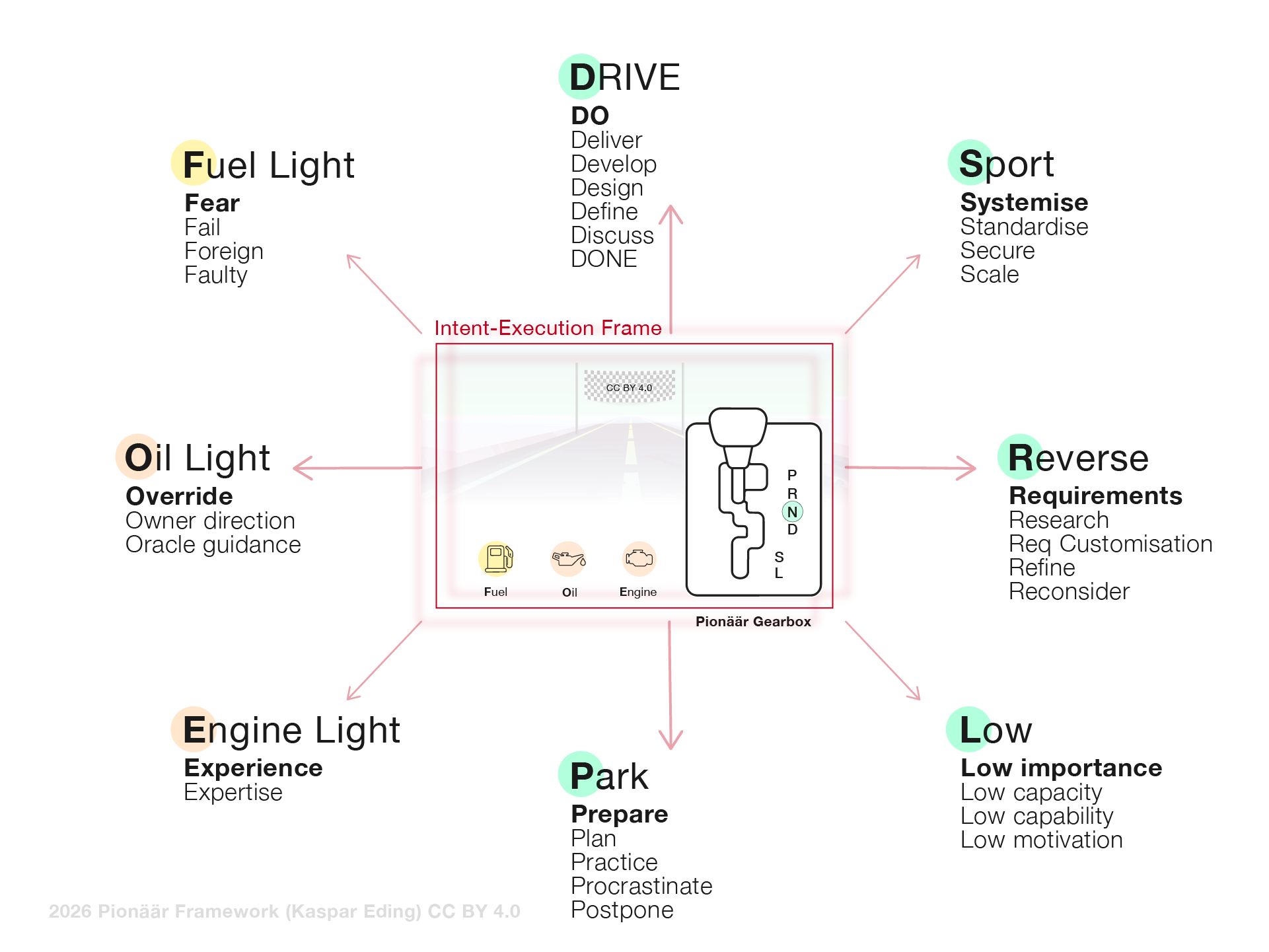
The 4 Visible Vectors
Usually acknowledged — plan created, boss approves, something ships, customer accepts
D Drive - Delivery Vector
The more you do, the more you're pulled toward DONE. At high drift: obsessed with solution, forgetting original problem.
Sequence: DO → Discuss → Define → Design → Develop → Deliver → DONE
- "We're almost done" when intent not satisfied
- Rushing to completion over alignment checks
- Solution delivered, problem unsolved
P Park - Planning Vector
The more you plan/prepare/practice, the harder it gets to start. At high drift: project parked indefinitely, too expensive to begin.
Pattern: Plan → Prepare → Practice → Procrastinate
- "We need more research before deciding"
- Preparation becomes the work
- Analysis paralysis disguised as diligence
R Requirements - Research Vector
The more you discover, the more there is to discover. The more you discuss requirements with customer, the smaller the feature impact. Real users direct UI/process, not product development. At high drift: scope shrunk to UX optimization, perpetual exploration, intent forgotten in fascination with findings.
Pattern: Research → Refine → Reconsider → Redesign → Requirement customisation
- "This is interesting!" replacing "Does this serve intent?"
- Scope expanding with each discovery
- Learning becomes the objective
O Owner/Oracle
Sponsor for intent execution. Can override any direction. Must be managed continuously like engine lights (OIL!).
Dynamic: Over-attention loses the race. Under-attention loses alignment. Classic pattern: Owner micromanages scope, PM held responsible for impact.
- Direction changes without intent renegotiation
- Authority overrides data
- Accountability assigned where authority absent
The 4 Invisible Vectors
These operate with equal power but without explicit recognition in plans:
S Sport - Systematizing Vector
Standardize, Secure, Scale. At high drift: abstracting before basics work, building reusable frameworks when specific solution needed.
Pattern: Systematize → Standardize → Secure → Scale
- "Let's make it reusable first"
- Architecture discussions before prototype exists
- Frameworks built for future cases, not current need
E Experience/Expertise
Experts insist on standard solutions regardless of intent. "We always build it this way."
Power: Expert credibility overrides stated need. Team delivers perfect standard solution that doesn't satisfy actual intent.
- "Best practice" applied without questioning fit
- Past success patterns enforced on new context
- Technique mastery prioritized over problem solving
F Fear
Fear pulls execution into unnecessary validation. Delays disguised as diligence.
Forms: Fear of failure, unfamiliar territory, making mistakes.
- Extra approval rounds "just to be safe"
- Pilot programs before pilot programs
- "What if" scenarios multiplying
L Low Motivation
Low capacity, low importance, low capability. Work deprioritized, energy drops, "not my job" thinking.
Invisible because: Looks like reasonable resource allocation. Treated as external constraint, not execution drift.
- Intent acknowledged, effort declining
- "Not enough resources" without reframing
- Energy drop unexplained
N Neutral Gear: Where You Reset
The only position that doesn't pull away from intent. Where you go to reduce vector positions and recalibrate.
What it looks like:
- Retrospectives (reflect, no immediate delivery)
- Intent realignment sessions (recalibrate, no execution)
- Token burn (process with no tangible output)
- Strategic pauses (reset, not rest)
Design principle: Build Neutral time into rhythm. Not emergency recovery—designed rhythm. The "waste" of reflection is the designed recovery mechanism. Without Neutral, all movement is away from intent.
Key Principles
Principle 1: Drift is multi-directional, not single threshold
Not "how much drift" but "which direction." D-drift looks different from P-drift, requires different interventions.
Principle 2: All vectors are equal
Mindless doing (D-drift) is NOT better than planning paralysis (P-drift). All pull frame away from intent with same result.
Principle 3: Four visible, four invisible
Plans typically account for D/P/S/R. Experience, Oracle, Fear, Low motivation operate unacknowledged with equal power.
Principle 4: Point of no return exists in each direction
At some drift level, data no longer breaks through—gets interpreted to fit drifted frame. Recovery becomes expensive or impossible.
Principle 5: Small windows principle
Check before drift compounds past recovery threshold. Not "check often" but "check before point of no return."
Principle 6: Design with gravity, don't fight it
Awareness doesn't prevent drift. Structure and rhythm accommodate it.
Diagnostic Framework
4 Major Vectors
The primary drift directions - visible, measurable, and frequently discussed:
| Vector | Name | Description |
|---|---|---|
| D | Drive / Delivery | Rushing to complete. Solution delivered but problem unsolved. "Almost done" loops. |
| P | Park / Planning | Preparation expands indefinitely. Decisions delayed for "more information." Planning becomes the work. |
| S | Sport / Systematizing | Abstraction before basics proven. "Make it reusable" precedes "make it work." Frameworks for hypotheticals. |
| R | Requirements / Customisation | Discovery expands scope continuously. "Interesting!" replaces "does this serve intent?" Learning as objective. |
4 Invisible Vectors
The hidden drift directions - harder to detect, often dismissed or unacknowledged:
| Vector | Name | Description |
|---|---|---|
| E | Experience / Expertise | Experts override data with "we always..." Past success patterns enforced on new context. |
| O | Oracle / Owner / Override | Sponsor overrides without intent renegotiation. Accountability assigned where authority absent. |
| F | Fear | Approval rounds multiply "to be safe." "What if" scenarios dominate. Validation exceeds actual risk. |
| L | Low Motivation | Acknowledged intent paired with declining effort. Capability gaps unaddressed. Unexplained energy drop. |
The Recovery State
The designed return point - not the absence of drift, but the intentional pause:
| Vector | Name | Description |
|---|---|---|
| N | Neutral | Intentional pause to check alignment. Reduce vector positions before they compound. Not emergency recovery - designed rhythm. |
Use these questions to identify dominant drift direction:
D-Drift (Delivery)
- Is solution delivered but problem unsolved?
- Does team resist pausing to verify alignment?
- Is "almost done" repeated while gaps remain?
P-Drift (Planning)
- Does preparation expand indefinitely?
- Are decisions delayed for "more information"?
- Has planning become the work itself?
S-Drift (Systematizing)
- Is abstraction happening before basics proven?
- Does "make it reusable" precede "make it work"?
- Are frameworks built for hypothetical future cases?
R-Drift (Research)
- Is discovery expanding scope continuously?
- Does "interesting!" replace "does this serve intent?"
- Is learning the objective vs means to objective?
E-Drift (Experience)
- Do experts override data with "we always..."?
- Is past success pattern enforced on new context?
- Does technique mastery trump problem fit?
O-Drift (Oracle)
- Does sponsor override without intent renegotiation?
- Is accountability assigned where authority absent?
- Do direction changes happen without alignment?
F-Drift (Fear)
- Are approval rounds multiplying "to be safe"?
- Do "what if" scenarios dominate decisions?
- Is validation exceeding actual risk?
L-Drift (Low Motivation)
- Is acknowledged intent paired with declining effort?
- Do capability gaps go unaddressed?
- Has energy drop gone unexplained?
Application to Your Practice
1. Identify Your Team's Dominant Vector
Use diagnostic framework. Most teams have 1-2 primary drift directions based on composition, history, incentives.
2. Design Checkpoints for That Vector
- D-drift → Intent alignment checks before "done"
- P-drift → Start triggers before "ready"
- S-drift → Prototype gates before architecture
- R-drift → Scope boundaries before discovery
- E-drift → Fit-for-context review before standard application
- O-drift → Sponsor sync rhythm built in
- F-drift → Risk thresholds defined upfront
- L-drift → Energy/capability checks in standups
3. Build Neutral Into Rhythm
Not emergency recovery. Designed rhythm. Weekly retrospectives, sprint reviews, quarterly strategy realignment. Create space to reduce vector positions before they compound.
4. Make Drift Visible Through Artifacts
Frame snapshots at decision points. Compare N vs N-1. Drift invisible from inside becomes visible through comparison.
Research Validation
The Gearbox Model emerged from 10+ years coordinating human strategic execution. Eight months documenting AI collaboration observed the mechanism with unprecedented precision.
What AI research revealed:
D-drift (Delivery): AI rushing to completion, solution delivered with problem unsolved. Corrections: "slow down, be systematic."
P-drift (Planning): AI expanding preparation, delaying start. Evidence: "The content of those tickets is lost" - planning replaced doing.
Discovery D6: Multiple Vectors Operate
"We're deep in D" — scope explosion, pressing through
"We've drifted a lot into the planning vector"
Different symptoms. Same recovery structure. Proves multi-directional physics.
Discovery D1: Rules Compress
Point of no return documented: "Instructions existed. They got compressed. When behavior was happening, working frame contained recent prompts + training defaults, not instruction content."
Discovery D16: Reprocessing = Rhythm
Neutral gear documented: "Reprocessing at rhythm intervals is the designed state. Failure to reprocess is the anomaly."
Substrate-independent pattern: Same drift vectors, same physics, same recovery mechanisms across human teams and AI systems.
Deploy the Gearbox Model
The Gearbox Drift Model is available as a copy/paste artifact for AI coordination. Use it as context when building coordination systems that need to catch drift in all 8 directions—not just delivery pressure.
Ready to Continue?
Next chapter shows how to shift objectives from delivery to capability—creating compression-resistant game frames that work WITH drift physics.
Chapter 4: Capability Over Delivery →